TL;DR: In Orange, CA, drywall water damage repair typically runs $400 to $900 for a small section dried in place, $800 to $4,500 for single-wall or full-room drywall replacement, and $4,000 to $10,000 or more when mold remediation and framing repair are involved. The number that matters most isn’t the square footage of drywall, it’s whether the water was clean, how long it sat, and how far it traveled into the wall cavity, insulation, and baseboard.
Maybe you pulled back a cabinet near Old Towne Orange and found the drywall under the sink gone soft and crumbly. Maybe a slow roof leak near Santiago Creek left a brown ring spreading across a ceiling, or a water heater near Chapman University let go overnight and soaked the baseboard along an entire wall. In every version of this, the same question comes up fast: does this drywall get dried and saved, or does it have to come out?
How Much Does Drywall Water Damage Repair Cost in Orange, CA?
Most drywall water damage jobs in Orange fall between $400 and $4,500, with the low end covering a small dried-in-place patch and the high end covering a full room of replacement after a significant leak. Jobs that involve mold behind the wall or structural framing repair run higher.
| Scenario | Typical Cost Range |
|---|---|
| Small area, Category 1 water, dried in place (no cut-out) | $400 - $900 |
| Single wall section replacement, clean water, up to 32 sq ft | $800 - $1,800 |
| Full room drywall replacement, clean to gray water | $1,800 - $4,500 |
| Ceiling drywall replacement (staining, sagging, or collapse) | $1,200 - $3,000 |
| Drywall, baseboard, and trim replacement across multiple rooms | $3,500 - $8,000 |
| Drywall replacement with mold remediation behind the wall | $4,000 - $10,000+ |
These are typical ranges for Orange County labor and material costs, not a quote. Every wall cavity hides something different once it’s opened, which is why a written scope after inspection matters more than a phone estimate.
What Decides Whether Drywall Gets Dried, Patched, or Replaced?
Whether drywall can be dried in place or has to be cut out comes down to the category of water, how long it sat, and how much the paper facing and gypsum core have absorbed. Drywall is porous paper over gypsum, so it holds water like a sponge and breaks down from the inside before it looks damaged on the surface.
Under the ANSI/IICRC S500 standard, water is classified by source. Category 1 (clean water), such as a supply line break, can sometimes be dried in place if it’s caught within the first 24 to 48 hours and the drywall hasn’t swollen or lost structural integrity. Category 2 (gray water, from a washing machine discharge or a toilet overflow without feces) and Category 3 (black water, from sewage or storm flooding) call for removing affected porous materials rather than drying them, because the contamination can’t be fully flushed out of the gypsum core.
A few practical signs that drywall needs to come out instead of dry in place:
- It’s soft, sagging, or crumbles when pressed
- The water sat for more than 48 hours before anyone found it
- It’s gray or black water from any source
- Baseboard along the wall has swollen, warped, or separated from the drywall, which usually means water tracked down inside the wall cavity, not just across the surface
- There’s a musty smell or visible staining spreading, which often signals mold already growing behind the drywall where it can’t be seen
Mold can begin colonizing a wet surface within 24 to 48 hours, according to the EPA, so the clock on “dry it or replace it” is shorter than most homeowners expect.
Does Homeowners Insurance Cover Drywall Water Damage Repair?
Most homeowners policies cover drywall repair when the water damage is sudden and accidental, like a burst supply line or a failed appliance hose, but they generally exclude gradual leaks and wear over time. A slow leak behind a wall that went unnoticed for weeks is the scenario insurers most often deny.
The duty to mitigate matters here too: starting extraction and drying quickly protects the claim, and documenting the damage with photos before any drywall comes out gives the adjuster something concrete to work from. Coverage for mold that grows after a covered water loss is often capped or limited, so getting drying started inside that 24 to 48 hour window isn’t just about saving material cost, it’s about keeping the claim clean. For a fuller breakdown of what’s typically covered, see our guide to homeowners insurance and water damage and the Insurance Information Institute’s overview of standard coverage.
What Does the Drywall Repair Process Look Like After Water Damage?
The process runs in a set order: extract standing water, measure moisture in the wall cavity, remove only what can’t be dried, dry the rest in place, then rebuild. Skipping the moisture-mapping step is how homeowners end up repainting over a wall that’s still wet behind the surface.
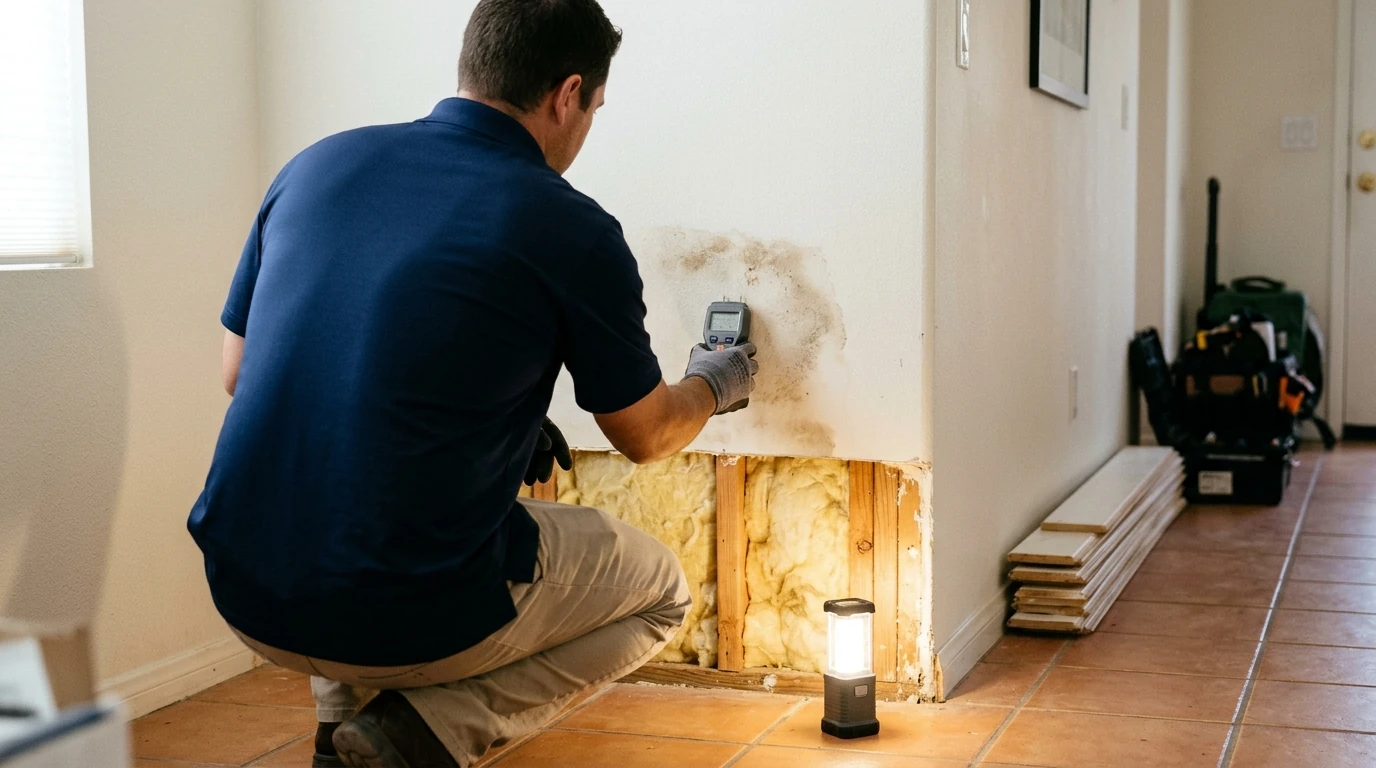
- Extraction and assessment. Standing water comes out first, and a moisture meter is used to map how far water traveled into the wall, not just how it looks on the surface.
- Flood cuts, if needed. When drywall has to come out, it’s typically cut in a straight line a foot or more above the visible waterline, because wicking pulls water higher than it appears.
- Drying. Air movers and a dehumidifier run on the remaining structure, with daily moisture readings until the studs, subfloor, and any salvageable drywall hit a dry standard.
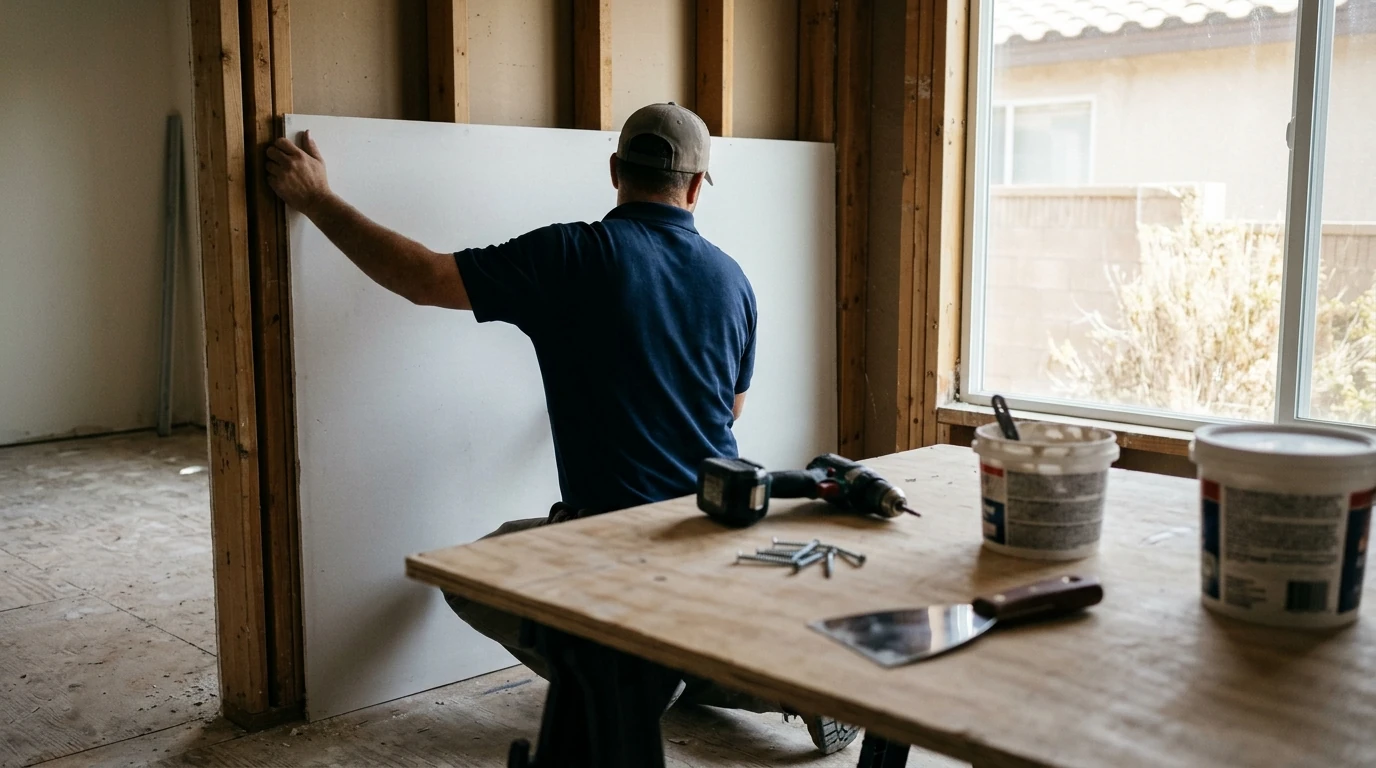
- Rebuild. New drywall goes up, taped, mudded, textured to match, and painted. Baseboard and trim are replaced to match the original profile where possible.
This is also where drywall repair crosses into reconstruction work rather than straight restoration: hanging new sheets, matching texture, and re-trimming a room is a build task, not a drying task. If the water came from a sudden, covered loss and you’d rather have one team carry the job from drying through rebuild instead of coordinating a dry-out company and a separate contractor, HHI Restoration handles both phases for properties across Orange and the surrounding cities. For a closer look at how that rebuild phase works, see our general contracting and reconstruction guide for Orange, CA.
If the inspection turns up a musty smell, discoloration, or water that sat more than two days, it’s worth having that checked before the wall closes back up. Mold remediation done after the drywall is already painted means opening it back up a second time.
About the Company
This IICRC-certified restoration and general contracting company has served Orange, CA and nearby Orange County cities since 2004 under California contractor license #960721. Its crews handle water damage restoration, structural drying, mold remediation, and the reconstruction work that follows, including drywall, framing, and trim repair, so a single team can carry a job from extraction through rebuild. Call HHI Restoration at (714) 209-7719 to schedule a moisture assessment before deciding whether a wall gets dried, patched, or replaced.