24/7 Emergency Water Removal & Cleanup in Orange
24/7 emergency water removal & cleanup in Orange and surrounding areas. IICRC-certified, insurance billing accepted. Call (714) 209-7719.
Water spreading across the floor right now? Call (714) 209-7719. We answer 24/7, and every minute standing water sits on flooring, drywall, or subfloor is a minute closer to the point where materials have to be torn out instead of dried in place.
A burst supply line, an overflowing washing machine, or a failed sump pump doesn’t wait for business hours, and neither does the damage. Water moves by gravity and capillary action within minutes, wicking into baseboards, migrating under engineered flooring, and soaking into wall cavities where it’s invisible from the room. By hour 24, untreated water damage typically starts supporting mold growth. This is the service that stops that clock: pulling standing water out fast, then drying the structure itself, not just the surface.
What Emergency Water Removal & Cleanup actually involves
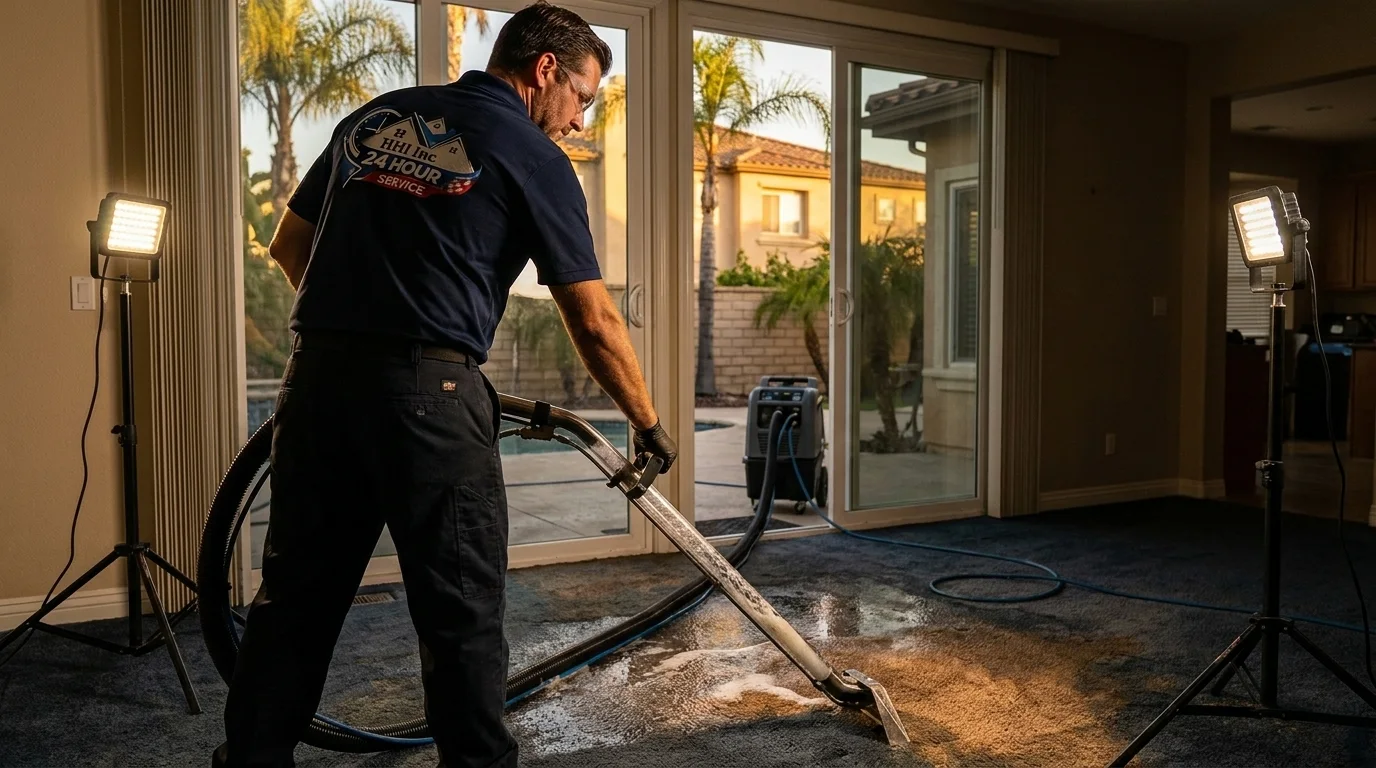
This is the extraction-and-dry-down phase that happens before any rebuild or cosmetic repair. Crews bring truck-mounted or portable extraction units rated for the volume of water on site, moisture meters to map how far water has traveled into walls and subfloor, and thermal imaging to find wet pockets that look dry on the surface but aren’t. Standing water removal comes first: carpet, pad, and any pooled water on hard flooring. Then the slower work starts, positioning air movers and dehumidifiers to pull moisture out of framing, drywall, and subfloor over several days, with moisture readings logged at intervals so everyone, including the insurance adjuster, can see the structure actually reaching dry standard rather than just looking dry.
Category matters here. Clean water from a supply line is handled differently than water that’s been sitting, or water with any contamination risk, which changes what materials can be dried versus what has to come out.
Our process
- Source control and water extraction. Stop or isolate the source where possible, then extract standing water with truck-mount or portable units, working from the deepest water outward.
- Moisture mapping. Moisture meters and thermal imaging identify how far water traveled into walls, subfloor, and cavities, not just what’s visible on the surface.
- Controlled demolition where needed. Saturated drywall, insulation, or flooring that can’t be dried in place is removed to stop ongoing moisture retention and open up wall cavities for airflow.
- Structural drying and monitoring. Air movers and dehumidifiers are positioned based on the moisture map, with daily readings tracked against a drying goal, not a fixed number of days.
- Final verification. Materials are confirmed at or near pre-loss moisture content before drying equipment comes out, with documentation ready for the claim file.
What separates a good emergency water removal response from a bad one
The most common mistake is treating this as a carpet-cleaning job: pull the visible water, run a couple of fans, call it done. Water that’s wicked into drywall or subfloor doesn’t dry on its own schedule just because the carpet feels dry to the touch. A rushed job leaves moisture trapped behind baseboards or under flooring, which is exactly where mold shows up two or three weeks later.
Insurance adjusters look for daily moisture logs, not just a start and end reading. They want to see the category of water documented at the time of loss, photos of affected materials before removal, and a clear record of what was dried versus what was removed and why. A response that skips this documentation often results in disputed claims later, because there’s no evidence the drying standard was actually met.
What does Emergency Water Removal & Cleanup cost?
Costs vary with how much water was involved, how long it sat before extraction started, and how many materials need to come out versus dry in place. Every loss gets a written scope before work begins, since no two water losses behave the same way once you’re inside the walls. Homeowners insurance typically covers sudden, accidental water damage, like a burst pipe or appliance failure, though coverage for gradual leaks or flood-source water can differ by policy, so it’s worth checking your declarations page.
| Scenario | Typical range |
|---|---|
| Single room, clean water, minimal materials removed | $1,200 - $3,500 |
| Multiple rooms, standing water, some drywall/flooring removal | $3,500 - $8,000 |
| Whole-floor loss with structural drying and monitoring | $8,000 - $15,000 |
| Water sat 24+ hours before extraction, added demolition | $10,000 - $20,000+ |
Seasonal & regional considerations
Orange’s rainy season and older neighborhoods with aging copper and galvanized plumbing both drive a steady share of these calls, particularly winter storms that overwhelm roof drainage or push water through foundation cracks in homes built before modern grading standards. Summer brings its own version: AC condensate lines and water heaters in attics or closets that fail quietly until a ceiling stain gives it away.
Service area
HHI Restoration responds to emergency water removal and cleanup calls across Orange and surrounding Orange County communities, including Santa Ana, Anaheim, Tustin, and Villa Park.
If water is actively spreading through your home right now, don’t wait on it. Call (714) 209-7719 to schedule emergency water extraction and start the drying process before materials have to come out instead of dry in place.
Services We Handle
- Clean
- Standing Water Removal
Frequently Asked Questions
Does homeowners insurance cover emergency water removal & cleanup?
How do you know if water has gotten into the walls or subfloor, not just the surface?
How long does structural drying usually take after standing water is removed?
What's the difference between extracting standing water and full structural drying?
Should I throw out wet carpet and drywall myself before you arrive?
Looking for the best emergency water removal & cleanup company in Orange?
HHI Restoration provides licensed and insured emergency water removal & cleanup in Orange, CA and the surrounding area, and has served local property owners since 2004. Customers rate us 4.8 out of 5 stars across 23 Google reviews. We answer calls 24/7 — call (714) 209-7719 for immediate help.
Need Emergency Water Removal & Cleanup now?
We respond 24/7 across Orange and surrounding CA cities.