If you’re asking this question, water has probably already found its way into your home and you’re staring at a stain on the ceiling or a soaked patch of carpet wondering what it’s going to cost you. The short answer: homeowners insurance typically covers water damage that’s sudden and accidental, like a burst pipe or an overflowing washing machine, but it usually excludes damage from gradual leaks, poor maintenance, or flooding from outside the home. The difference between those categories often decides whether your claim gets approved or denied, so it’s worth understanding before you call your adjuster.
Sudden vs. Gradual: The Line Insurers Actually Draw
Most homeowners policies use some version of the phrase “sudden and accidental” to describe covered water losses. A supply line that bursts behind the dishwasher, a pipe that cracks during a cold snap, or a water heater that fails overnight all tend to fall into this category, because the damage happened fast and you couldn’t have reasonably prevented it.
What usually gets excluded is damage that built up over time: a slow drip under a sink that’s been staining the cabinet for months, a roof leak you’ve noticed but put off repairing, or corrosion in old galvanized pipes that finally gave out. Insurers view these as maintenance issues, not sudden losses, and will often point to evidence of long-term moisture, like mold growth, rotted wood, or mineral staining, as proof the damage didn’t happen overnight.
This is also where flood insurance becomes a separate conversation. Standard homeowners policies almost universally exclude damage from external flooding, rising groundwater, or storm surge. That coverage requires a separate flood policy, usually through the National Flood Insurance Program or a private flood carrier. If storm water entered from outside rather than a failed pipe inside, your homeowners policy likely won’t apply at all.
What to Do in the First 24 Hours
- Stop the source if you can. Shut off the main water valve or the fixture’s local shutoff if a pipe or appliance is the cause. You can’t limit damage while water is still flowing.
- Photograph everything before you touch it. Wide shots of the room, close-ups of standing water, water lines on walls, and any damaged belongings. Insurers rely heavily on this early documentation.
- Note the time and likely cause. Write down when you noticed it and what you think happened. Adjusters ask about this, and a clear timeline supports a sudden-loss claim.
- Call your insurance company to open a claim. Most carriers want to be notified quickly, and delays can complicate the process.
- Start water removal if it’s safe to do so. Standing water left for more than a day or two invites secondary damage like swelling floors, warped cabinetry, and mold colonization, which can start within 24 to 48 hours in warm, humid conditions.
What Not to Do
- Don’t assume the adjuster will see it the way you do. Photos, dates, and a written account matter more than memory.
- Don’t start major demolition before the adjuster inspects, unless there’s an active safety hazard. Some insurers want to see the damage in place before repairs begin.
- Don’t ignore a musty smell because the carpet “looks dry.” Water travels under flooring and behind baseboards long after the surface feels fine, and a smell is often the first sign drywall or subfloor is still wet.
- Don’t wait to see if it dries on its own. The gap between “sudden water event” and “neglected moisture problem” in an insurer’s eyes is often just how long you waited to act.
- Don’t throw away damaged items before documenting them, especially furniture, flooring, or electronics that might factor into a contents claim.
When to Call a Restoration Professional
A small, visible puddle you can mop up yourself is one thing. Water that’s gotten into wall cavities, under flooring, or into a ceiling is another, because what you can see is rarely the full extent of it. Ceiling stains in particular tend to mean water has been sitting above the drywall for a while, and the longer it sits, the more likely the insulation and framing above it are compromised too.
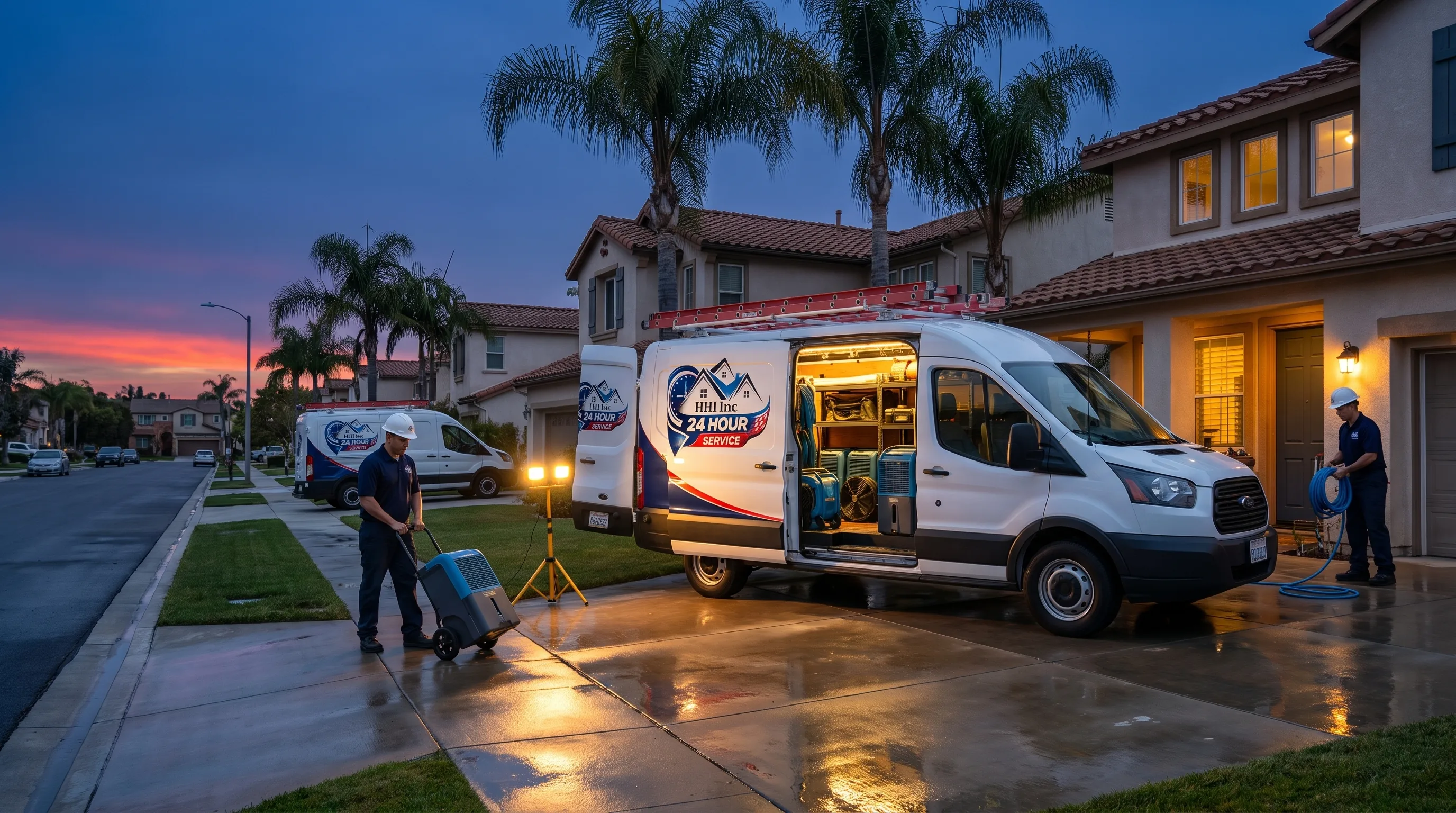
HHI Restoration provides water damage restoration and emergency water removal for homes in and around Orange, using moisture meters and thermal imaging to find water that’s migrated into walls, subfloors, and ceiling cavities rather than just drying what’s visible. That documentation, moisture readings, photos, and a written scope of the affected materials, also tends to strengthen the paper trail your insurance claim relies on. If the source was a water heater failure, a burst supply line, or a sewage backup, those are situations where a professional assessment early on can make the difference between a straightforward claim and a disputed one.
The Recovery Process, Step by Step
Once the source is stopped and the claim is open, recovery generally follows a few stages:
- Extraction. Standing water gets pumped or vacuumed out. The faster this happens, the less it spreads into adjacent materials.
- Assessment of hidden moisture. Moisture meters check drywall, subfloor, and framing that look dry on the surface but may still be saturated underneath.
- Drying and dehumidification. Industrial air movers and dehumidifiers run for several days, following IICRC S500 drying standards, to bring materials back to a normal moisture content rather than just a dry-to-the-touch state.
- Repair or reconstruction. Drywall, flooring, cabinetry, or trim that couldn’t be saved gets replaced. This is where your insurance adjuster’s scope of repairs and the contractor’s invoice need to line up.
- Final documentation. Photos, moisture logs, and a completion report close out the file, both for your records and for the insurer’s.
Throughout this process, keep your own folder of photos, receipts, and correspondence. Even with a straightforward sudden-loss claim, insurers sometimes ask for clarification weeks later, and having your own record saves time.
Water damage claims are rarely as simple as “covered” or “not covered.” The cause, the speed of your response, and how well the damage is documented all shape the outcome. If you’re dealing with a leak, a burst pipe, or standing water right now and aren’t sure whether it’s a DIY cleanup or something bigger, HHI Restoration can assess the damage and help you understand what you’re looking at before it turns into a bigger problem. Call (714) 209-7719 to talk through what you’re seeing.