Large Loss and Catastrophic Response in Orange
24/7 large loss and catastrophic response in Orange and surrounding areas. IICRC-certified, insurance billing accepted. Call (714) 209-7719.
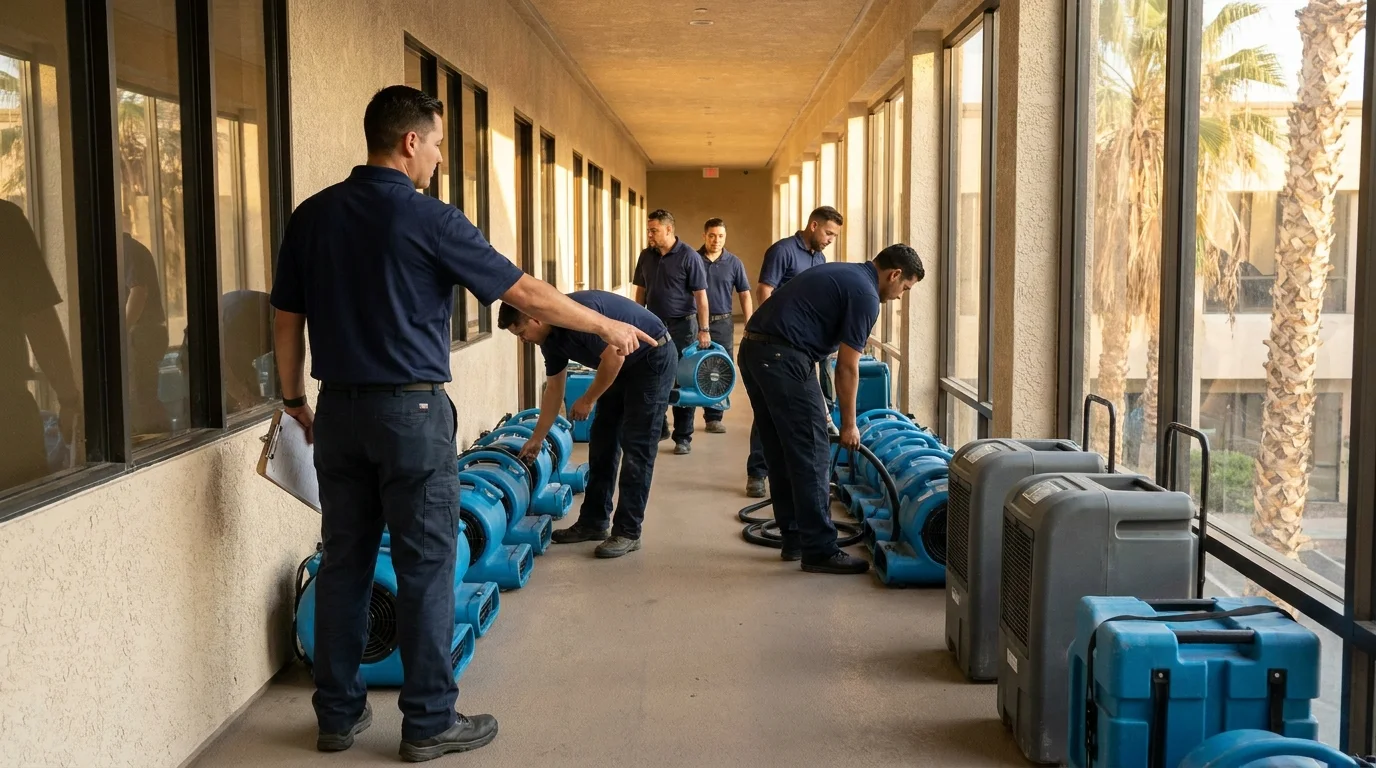
When a loss crosses a threshold, whether that’s a burst main flooding three floors of a mixed-use building in Orange, a fire that takes out a warehouse roof, or a storm event that damages a whole commercial campus, the standard one-crew, one-dumpster playbook stops working. Large loss and catastrophic response is a different scale of mobilization: multiple drying zones running simultaneously, a dedicated project manager coordinating with ownership and adjusters, and equipment deployed by the trailer-load instead of the truckload. HHI Restoration handles these losses as structured projects, not oversized service calls.
What large loss and catastrophic response actually involves
A large loss is typically defined by dollar value (often $50,000 and up), affected square footage, or complexity, such as a commercial building with multiple tenants, a multi-structure residential property, or a loss involving business interruption. The work itself still rests on the same science as a smaller job, moisture mapping, psychrometric calculations, structural drying, but at a scale that requires generator-backed power, multiple desiccant dehumidifiers running in parallel, and crews working in shifts to keep pace with the drying curve. Timelines run from days to weeks depending on the building’s construction, the water category involved, and how quickly utilities and site access are restored. Documentation volume is also heavier: hundreds of moisture readings, daily drying logs, and photo records that a carrier’s large loss unit will expect to see before authorizing continued work.
Our process
- Rapid site assessment and scope development. A senior project lead walks the affected structure, identifies all impacted zones, and builds a written scope that accounts for the full footprint of the loss, not just the areas visibly wet or burned.
- Multi-crew mobilization. Equipment and personnel are deployed in parallel across zones rather than sequentially, so a five-floor loss doesn’t take five times as long as a one-floor loss.
- Centralized moisture and progress tracking. Daily psychrometric readings across every zone feed into a single project log, so the property manager, ownership group, and adjuster are all working from the same data.
- Carrier and stakeholder coordination. On losses this size there’s usually a large loss adjuster, sometimes a third-party administrator, and often legal or risk management involvement. HHI Restoration provides the documentation format those parties expect, updated on a schedule rather than only at project close.
- Phased reconstruction handoff. Once drying and remediation are verified complete, scope transitions into reconstruction planning so there’s no gap between mitigation and rebuild.
What separates a good large loss response from a bad one
The most common failure on big losses isn’t technical, it’s coordination. Crews start drying before the full scope is mapped, so new wet areas get discovered on day four instead of day one, which resets drying timelines and frustrates adjusters who were told the job was nearly done. Under-equipping a job is another frequent mistake: running residential-grade equipment counts on a commercial-scale loss means the drying goals are never actually hit, even though logs show equipment “running.” Adjusters evaluating a large loss file look for consistent daily documentation, equipment placement that matches the moisture readings, and a scope that was revised in writing when conditions changed, not silently. A response that holds up under claim review is one where the paperwork and the physical work tell the same story from day one.
What does large loss and catastrophic response cost?
Costs on large and catastrophic losses vary enormously based on square footage, number of affected zones, water or fire category, and how much of the structure requires reconstruction versus mitigation only. These figures are typical industry ranges, not a quote: every loss gets its own written scope from HHI Restoration before work begins, and commercial or homeowners insurance typically covers large loss mitigation and reconstruction when the cause is a sudden, covered event, subject to the policy’s specific terms and any business interruption provisions.
| Scenario | Typical range |
|---|---|
| Multi-unit residential water loss (3-10 units) | $75,000 - $250,000 |
| Mid-size commercial fire, single structure | $150,000 - $500,000 |
| Large commercial water loss with multiple floors | $200,000 - $750,000 |
| Industrial facility flood or storm loss | $300,000 - $1,000,000+ |
| Multi-structure catastrophic storm damage | $500,000 - $2,000,000+ |
Seasonal & regional considerations
Orange County’s storm season brings concentrated rain events that can overwhelm aging commercial roofing and drainage systems built for a drier baseline climate, turning a single roof failure into a multi-tenant water loss overnight. Older industrial and mixed-use buildings in the region, many built before current stormwater codes, are more prone to this kind of cascading damage when a single point of failure isn’t caught early. Large loss mobilizations tend to spike after regional storm systems move through, when multiple properties in the same area are affected at once and demand for equipment and crews rises sharply.
Service area
HHI Restoration responds to large loss and catastrophic events throughout Orange and the surrounding Orange County communities, including commercial, industrial, and multi-family properties across the region.
If your property is facing a loss that’s bigger than a standard claim, call (714) 209-7719 to get a project lead and a written scope moving before the damage compounds.
Frequently Asked Questions
What qualifies a loss as "large loss" rather than a standard claim?
Does homeowners or commercial insurance cover large loss and catastrophic response?
How does equipment mobilization differ on a catastrophic loss versus a typical job?
Who coordinates with the adjuster on a multi-million dollar restoration claim?
What happens if new damage is discovered after mitigation has already started?
Looking for the best large loss and catastrophic response company in Orange?
HHI Restoration provides licensed and insured large loss and catastrophic response in Orange, CA and the surrounding area, and has served local property owners since 2004. Customers rate us 4.8 out of 5 stars across 23 Google reviews. We answer calls 24/7 — call (714) 209-7719 for immediate help.
Need Large Loss and Catastrophic Response now?
We respond 24/7 across Orange and surrounding CA cities.