Industrial Restoration in Orange
24/7 industrial restoration in Orange and surrounding areas. IICRC-certified, insurance billing accepted. Call (714) 209-7719.
Industrial losses don’t behave like residential ones. A burst line in a warehouse doesn’t just wet a floor, it can travel under racking, saturate pallet loads, and reach electrical panels before anyone notices the puddle. A fire in a manufacturing plant leaves soot embedded in machinery housings and HVAC runs that keep recirculating it long after the flames are out. The scale, the equipment at risk, and the pressure to get a production line back online all change how the work has to be done.
What Industrial Restoration actually involves
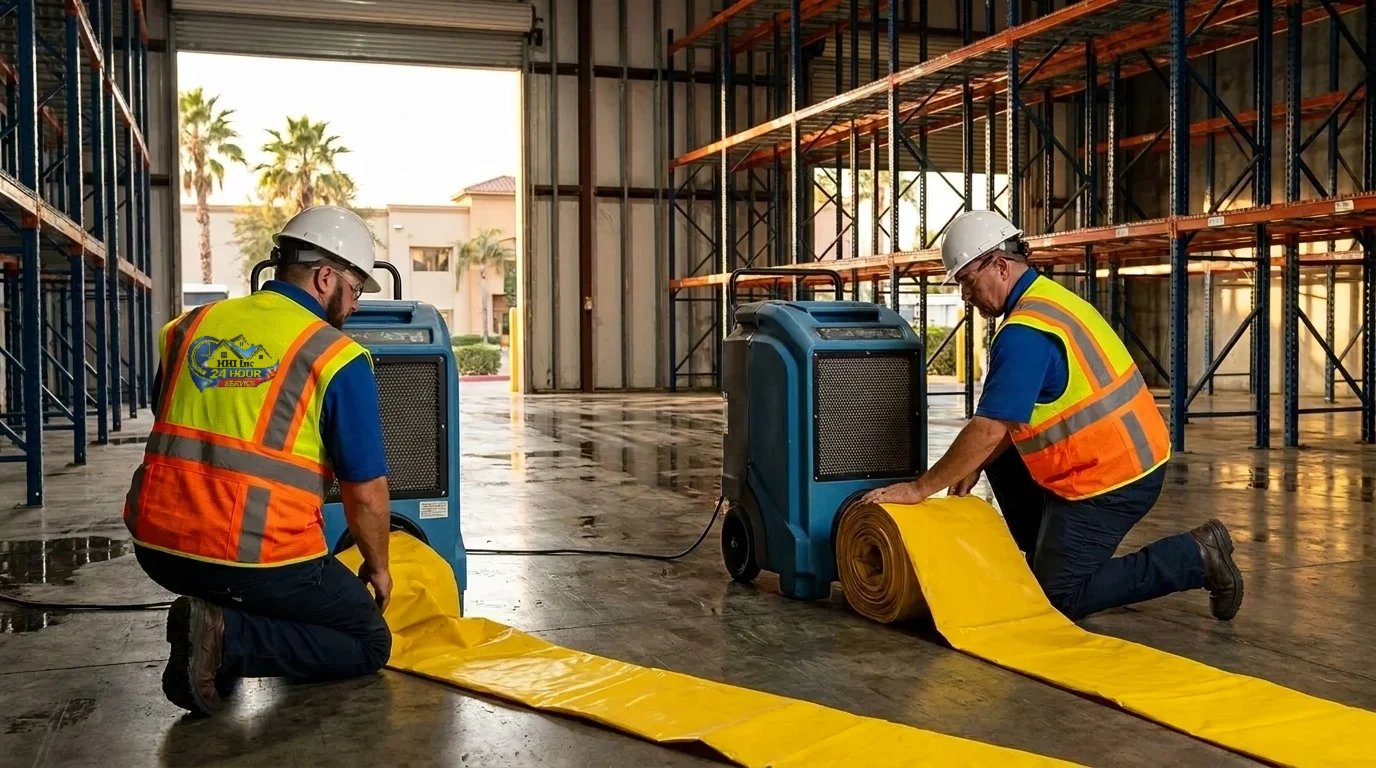
Industrial restoration covers water, fire, smoke, and storm losses inside warehouses, manufacturing plants, distribution centers, and processing facilities, anywhere the building footprint, ceiling heights, and equipment density call for a different approach than a house or small office. The square footage alone changes the math: a 40,000 square foot warehouse floor needs industrial-grade desiccant dehumidification, not a handful of residential air movers, and drying timelines get tracked zone by zone rather than room by room. Machinery and inventory add another layer. Metal components start corroding within hours of water exposure, and electrical and control systems need to be powered down and evaluated before any drying equipment runs near them. Fire losses bring their own complications, soot residue settles into motor housings, conveyor systems, and overhead ductwork, and it has to be identified and addressed before equipment is restarted. On facilities with legacy insulation or older construction, asbestos-containing materials sometimes surface once walls or ceilings are opened up, which is a separate scope we handle directly rather than working around.
Our process
- Site assessment and hazard walkthrough. Before any equipment goes in, we walk the affected area with facility management to map electrical panels, machinery, confined spaces, and any zones that need to stay operational during the work.
- Extraction and containment at scale. Industrial pumps and truck-mounted extraction handle standing water across large floor areas, and containment barriers isolate the affected zone so unaffected parts of the facility can keep running.
- Equipment and machinery protection. Exposed metal surfaces get treated to slow corrosion, and sensitive equipment is flagged for inspection or professional cleaning before it’s powered back on.
- Zone-by-zone structural drying and monitoring. Moisture readings get logged across the footprint rather than assumed from a single reading, since large open spans dry unevenly depending on airflow, insulation, and slab type.
- Scope handoff for repairs. Once the space is dry and documented, we provide a written scope for any reconstruction or finish work needed to bring the area back to pre-loss condition.
What separates a good Industrial Restoration response from a bad one
The most common mistake on industrial losses is treating them like an oversized residential job: more air movers, same process. That approach misses the things that actually matter at scale, undocumented moisture pockets under raised flooring or behind wall panels that read dry on the surface, metal components that needed corrosion treatment within the first few hours and didn’t get it, and soot that settled into HVAC systems and kept recontaminating cleaned areas. Insurance adjusters reviewing industrial claims look closely at documentation: moisture logs across zones, photos of affected inventory and equipment, and a clear timeline from mitigation to dry-out. A response that skips the logging or treats the whole facility as one zone tends to get pushback during the claims review, which slows down reimbursement and extends downtime.
What does Industrial Restoration cost?
Industrial losses vary enormously depending on square footage, what’s stored or manufactured on-site, and whether production has to stop during the work. The ranges below are typical industry figures for comparable losses, not a quote, every facility gets a written scope before work begins because the variables are different every time. Business and commercial property insurance often covers sudden water or fire losses in industrial buildings, though coverage for inventory, equipment, and business interruption varies by policy and should be confirmed with the carrier directly.
| Scenario | Typical range |
|---|---|
| Localized leak, small storage area | $3,000 - $9,000 |
| Warehouse floor water intrusion, moderate footprint | $15,000 - $50,000 |
| Large manufacturing floor, water + equipment exposure | $50,000 - $150,000+ |
| Fire/smoke damage, single production zone | $25,000 - $80,000 |
| Facility-wide fire or flood event | $150,000+ |
Seasonal & regional considerations
Orange County’s warmer months bring higher humidity loads that slow drying times inside large, poorly ventilated industrial spaces, which is part of why desiccant dehumidification rather than standard refrigerant units is often the right call for bigger footprints. Winter storm systems moving through the region put older warehouse roofing and loading dock seals under stress, and facilities with flat or low-slope roofs tend to see water intrusion concentrated near drains and parapet walls rather than spread evenly across the floor.
Service area
HHI Restoration is based in Orange, CA and responds to industrial facilities throughout Orange County, including nearby cities in the surrounding area. Facility-specific details, local permitting contacts, and typical building stock for each city are covered on our local service pages.
If a water, fire, or storm event has hit your warehouse or production floor, the longer equipment sits exposed, the more it costs to fix. Call (714) 209-7719 to get an industrial restoration assessment scheduled and a written scope in hand before damage spreads further.
Frequently Asked Questions
Does insurance cover industrial restoration losses?
How is drying different on a warehouse floor compared to a house?
Can we keep part of the facility running during restoration?
What happens to machinery and equipment exposed to water or soot?
What if asbestos-containing materials turn up during the work?
Looking for the best industrial restoration company in Orange?
HHI Restoration provides licensed and insured industrial restoration in Orange, CA and the surrounding area, and has served local property owners since 2004. Customers rate us 4.8 out of 5 stars across 23 Google reviews. We answer calls 24/7 — call (714) 209-7719 for immediate help.
Need Industrial Restoration now?
We respond 24/7 across Orange and surrounding CA cities.