24/7 Emergency Ceiling Water Damage Repair in Orange
24/7 emergency ceiling water damage repair in Orange and surrounding areas. IICRC-certified, insurance billing accepted. Call (714) 209-7719.
Water coming through your ceiling right now? Call now before a wet patch becomes a collapsed section of drywall. We answer 24/7 and can talk you through what to shut off and where to set a bucket while a crew gets routed to you.
A ceiling leak rarely announces itself all at once. It starts as a faint yellow-brown ring, maybe a soft spot you only notice when you press on it, or a faint musty smell drifting down from the attic side. By the time you see sagging drywall or hear a slow drip behind the texture, water has usually been sitting in the cavity for days, soaking insulation, saturating drywall paper, and working its way along ceiling joists toward the nearest low point. Left alone, that weight eventually wins.
What Ceiling Water Damage Repair actually involves
Ceiling repair is really two jobs stacked together: finding and stopping whatever is feeding water into the cavity, and then drying and rebuilding the ceiling assembly itself. The source might be a roof penetration, a failed flashing, a slow drain line from an upstairs bathroom, a condensing HVAC line, or a supply line that finally gave out. Until that source is confirmed, patching the visible stain is just cosmetic work on top of an active problem.
Once the source is controlled, the technical part starts. Drywall and plaster absorb water differently, plaster holds moisture longer and telegraphs damage less obviously, which matters in a lot of Orange’s older housing stock. Moisture meters and, where useful, thermal imaging tell us how far the water has traveled laterally along the joists, not just how big the visible stain looks from the floor. That’s often wider than homeowners expect.
Our process
- Moisture mapping and source tracing. We use moisture meters and visual inspection to trace the leak path through the ceiling cavity and confirm where water is actually entering, not just where it’s pooling.
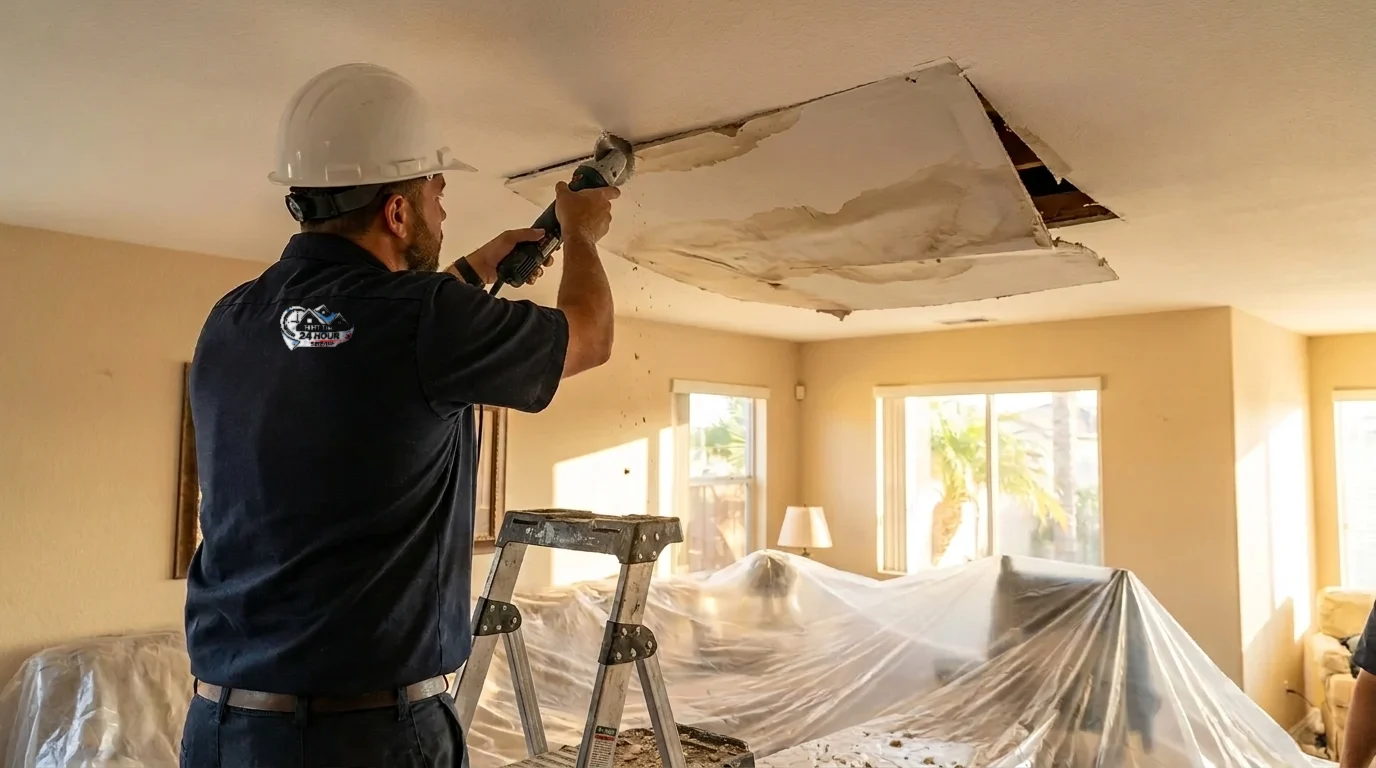
- Controlled relief and containment. If water is actively trapped behind sagging drywall, we relieve it in a controlled way rather than letting it find its own exit point, and we set up containment to protect flooring and contents below.
- Selective material removal. Saturated drywall, plaster, and insulation are removed only where moisture readings confirm damage, leaving sound material intact to minimize rebuild scope.
- Structural drying. Air movers and dehumidifiers target the open ceiling cavity and exposed framing, with moisture levels checked over the following days until the joists and surrounding structure read dry, not just surface-dry.
- Repair and refinish. New drywall or plaster is installed, taped, textured to match the existing ceiling, and painted so the repair blends rather than standing out as a patch.
What separates a good ceiling repair response from a bad one
The most common mistake is treating the stain as the whole problem. A crew that repaints over a water stain without checking the cavity above it is gambling that the leak was a one-time event and that the insulation and framing underneath dried on their own. Insurance adjusters know this, and they’ll ask for moisture readings and photos documenting the cavity before any drywall goes back up, not just after.
Another frequent error is cutting too little drywall to save on material, which leaves damp edges that bubble or stain again within weeks, or cutting too much, which turns a $900 patch into an unnecessary full ceiling replacement. Saturated insulation gets missed often, too. Wet fiberglass or cellulose loses R-value and can hold moisture against the framing long after the visible drywall looks dry, which is exactly the kind of hidden moisture that leads to callbacks.
What does Ceiling Water Damage Repair cost?
Every ceiling leak behaves differently depending on the water source, how long it went unnoticed, and whether the ceiling is drywall or older plaster, so HHI Restoration provides a written scope of repair before any work begins rather than a phone estimate. Homeowners insurance typically covers ceiling water damage repair when the cause is sudden and accidental, such as a burst pipe, though gradual leaks from long-term neglect are often excluded, so it’s worth reviewing your policy language. The ranges below reflect typical industry costs, not a quoted price for your specific repair.
| Scenario | Typical range |
|---|---|
| Minor stain, no sagging, small patch | $350 - $800 |
| Localized saturated drywall, single room | $800 - $2,200 |
| Sagging ceiling with insulation replacement | $1,500 - $4,000 |
| Plaster ceiling repair, older home | $2,000 - $5,500 |
| Multi-room or structural framing repair | $4,000 - $10,000+ |
Seasonal & regional considerations
Orange’s rainy season, generally December through March, is when roof flashing failures and clogged gutters show up as ceiling stains, especially on homes with low-slope or tile roofs where a single cracked tile can go unnoticed for a season. Outside of storm months, the more common culprit in this area is aging plumbing, upstairs bathroom supply lines and shower pans in homes built decades ago, where a slow leak can run for weeks before it surfaces as a ceiling stain below.
Service area
HHI Restoration repairs ceiling water damage throughout Orange, CA and the surrounding Orange County communities, working on everything from newer slab-on-grade homes to older plaster-ceiling construction common in the area’s established neighborhoods.
If water is actively coming through your ceiling or you’ve spotted a spreading stain, call (714) 209-7719 to schedule a moisture assessment before the damage spreads further into the structure.
Frequently Asked Questions
Does homeowners insurance cover ceiling water damage repair?
How do you know if a ceiling stain means active water damage or an old, resolved leak?
Is a sagging ceiling dangerous, and should I relieve it myself?
Will you repair the roof or plumbing issue causing the leak, or just the ceiling?
How long does the ceiling stay open before it can be rebuilt?
Looking for the best ceiling water damage repair company in Orange?
HHI Restoration provides licensed and insured ceiling water damage repair in Orange, CA and the surrounding area, and has served local property owners since 2004. Customers rate us 4.8 out of 5 stars across 23 Google reviews. We answer calls 24/7 — call (714) 209-7719 for immediate help.
Need Ceiling Water Damage Repair now?
We respond 24/7 across Orange and surrounding CA cities.